

Thirty Years of Art, Community, and Change
My Journey with Grand Rapids, KCAD, and ArtPrize

- Artists
- Community
- Volunteers
When I arrived in Grand Rapids in 1995, it wasn’t yet the city you might recognize today. I came here to attend Kendall College of Art and Design (KCAD), eager to pursue my education in a creative environment. At that time, Grand Rapids was a city with deep industrial roots, known for its furniture manufacturing legacy and often referred to as “Furniture City.” It was a place with strong ties to its past, but one where the arts and culture scene was still finding its footing, especially on a scale that would position the city on a national — or even international — stage.
Over the thirty years that I have called this city home, I have watched it transform, reshaping its identity through investment, creative leadership, and an evolving arts and entertainment culture. From new public spaces to the expansion of museums, music venues, and festivals, Grand Rapids has become a city known for fostering creative energy and celebrating artistic expression. And if there’s one initiative that has profoundly redefined the city’s identity and relationship to the arts, it is without question ArtPrize.
The Beginning of an Experiment
When ArtPrize was first announced in 2009, it was described as a radically open, independently organized international art competition. The brainchild of entrepreneur Rick DeVos, ArtPrize was an experiment, both bold and unprecedented in its structure and ambition. The idea was simple yet revolutionary: art would fill the city for 18 days each fall, with venues ranging from coffee shops to hotels, public parks to bridges, museums to church basements. Anyone could enter, anyone could exhibit, and the public would decide who won the substantial cash prizes.
At the time, I was teaching part time at KCAD while also working as a corporate workplace designer. From its first iteration, I made it a point to attend annually, often accompanied by friends, family, students, and colleagues. The city seemed to hum with energy during those weeks, with crowds wandering in and out of buildings they might otherwise never enter, conversations unfolding between strangers in front of unexpected installations, and art turning up in every corner of the urban landscape.
For me, one of the most powerful aspects of ArtPrize was how it transformed Grand Rapids' identity, connecting it to a long tradition of public art that stretched back to the city’s relationship with Alexander Calder. The Calder stabile, officially titled La Grande Vitesse, was installed in 1969 and became the first piece of public art funded by the National Endowment for the Arts. It’s a striking, bright red sculpture that has become emblematic of Grand Rapids itself.
Interestingly, ArtPrize chose this very work to repurpose as part of its own logo — turning the iconic form on its side as a gesture both of reverence and disruption. It was a symbol that said: this is a city with a history of public art, and it’s time to build on that history in new and surprising ways.
Engaging with the Work and the Community
As ArtPrize established itself as a fixture of the Grand Rapids cultural calendar, my role at KCAD expanded as well. Moving into a full-time faculty position, I found myself with more opportunities to engage not only with the event but also with the local and visiting artists it attracted. I developed a personal tradition of challenging myself to visit a different venue each day during the event. In the early years, it was easy to feel overwhelmed by the sheer volume of work on display and the multitude of spaces scattered across downtown.
By taking it one venue at a time, I was able to slow down, experience the work on its own terms, and have meaningful interactions with the artists who often accompanied their pieces. I would share this approach with my students, encouraging them to view ArtPrize not just as a spectacle but as a chance to hone their critical eye, engage with public art in unconventional settings, and reflect on how art functions outside the traditional confines of galleries and museums.
Those years taught me the importance of approaching big experiences incrementally — a lesson not only useful for navigating ArtPrize but for life and creative practice in general. It also prepared me for what became a beloved tradition: acting as an informal guide for friends and family who came to visit during the event. I’d curate routes for them, taking them to my favorite pieces and venues, weaving together conversations about design, creativity, and the evolving identity of the city.
From Spectator to Organizer
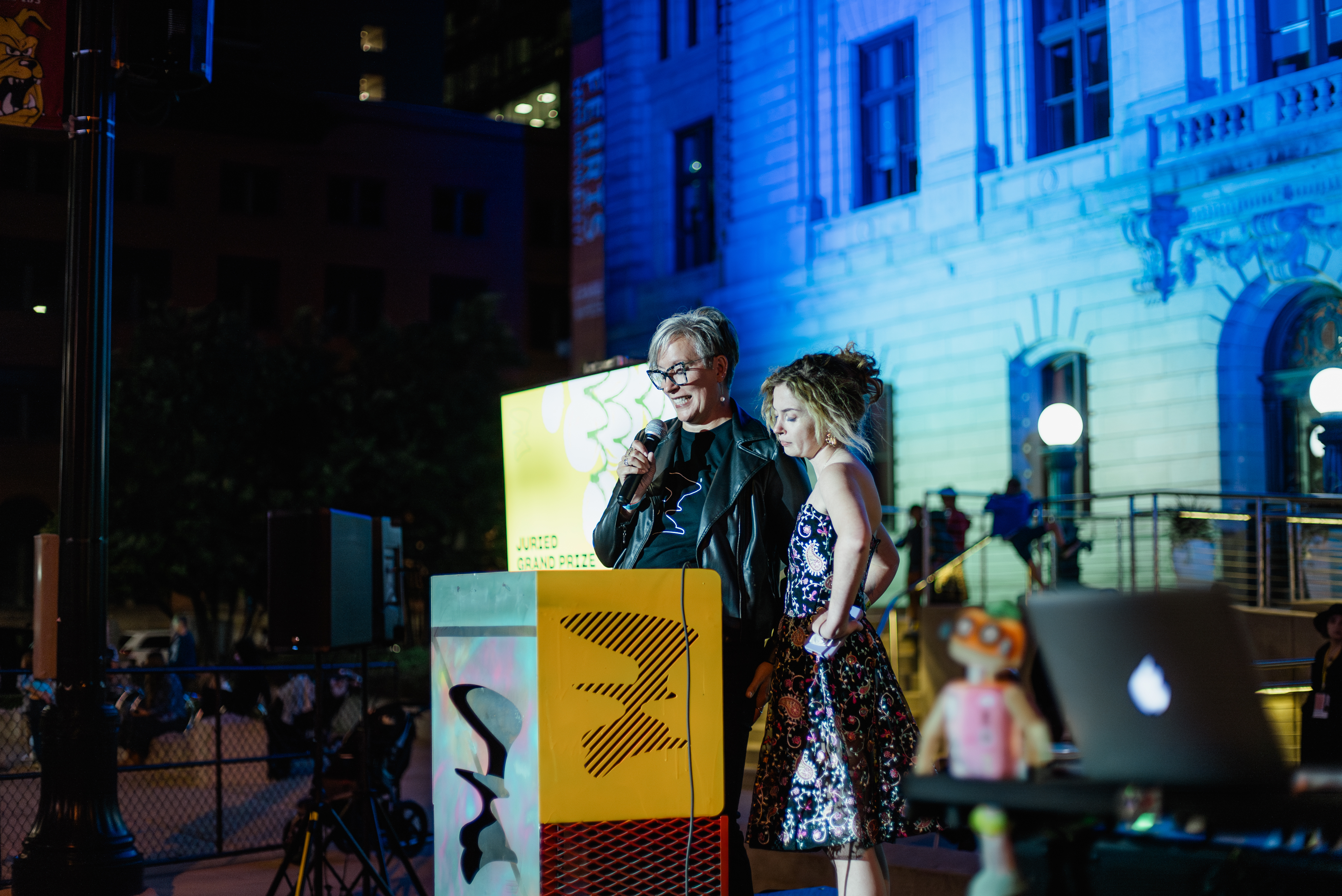
In time, my relationship to both KCAD and ArtPrize deepened. I was honored to step into the role of President at KCAD, which gave me the chance to not only represent the college at civic and cultural events but to help shape the conversations about art and design happening in our community. Around this time, I was also invited to join the Board of Directors for ArtPrize — a role I took seriously, understanding that this organization’s decisions would influence not just the local arts scene, but the cultural and economic vitality of Grand Rapids itself.
As one of the creative voices on the board, I made it a point to center the simple, essential truth that there is no ArtPrize without art and artists. It sounds obvious, but in any organization — particularly one as complex and high-profile as ArtPrize — it can be easy to get caught up in logistics, sponsorships, metrics, and media attention. My role was to continually bring the conversation back to the artists: how are we supporting them? How are we creating meaningful opportunities for emerging and established artists alike? How are we facilitating encounters between artists and the public in ways that foster understanding and connection?
In 2022, ArtPrize announced what was then considered its final iteration. After over a decade of operation, the organizers shared that the time had come to sunset the event in its current form. The announcement sent ripples through the community — for many of us, it was difficult to imagine a September in Grand Rapids without ArtPrize animating the streets.
A New Chapter: Creative Collaboration
Not long after the announcement, I received a call from the leadership team at the City of Grand Rapids. They shared a vision: the city needed to continue ArtPrize in some form and wanted a creative partner to help reimagine what that could look like. They believed KCAD was the right collaborator for this next chapter. My immediate response was a mixture of curiosity and cautious optimism. “That seems interesting,” I said. “Tell me more about what you’re thinking…”
From those initial conversations, a new collaboration emerged. The City of Grand Rapids, Kendall College of Art and Design of Ferris State University (KCAD), and Downtown Grand Rapids Inc. (DGRI) came together as core partners, each bringing unique resources, perspectives, and networks to the table. Our shared goal was to keep the spirit of ArtPrize alive while finding ways to evolve the format to sustain the needs of artists, audiences, and the city itself.
Today, I continue to serve on the ArtPrize Steering Committee, where I contribute as a creative advisor, advocate, and connector. It’s work that I value deeply — not only because of what ArtPrize means to our city but because of what it represents about the power of collaboration between civic, educational, and cultural institutions.
Impact on KCAD and the Next Generation of Creatives
For KCAD, this collaboration has had a profound impact. Our students have opportunities to engage with ArtPrize not just as viewers but as participants, volunteers, and interns. We’ve worked closely with ArtPrize leadership to develop and expand a robust internship program, offering KCAD and Ferris State University students valuable real-world experience in arts administration, event planning, public relations, and creative production.
Moreover, many KCAD alumni now work for ArtPrize or are deeply involved in the local arts and design community shaped by the event’s presence. The KCAD campus, centrally located in downtown Grand Rapids, plays an essential role as a host venue, artist headquarters, and hub for creative activity year-round.
Being embedded in an environment where creativity is not only valued but operationalized on such a large scale has been transformative for our students. It offers them a tangible example of how the arts can be a force for civic engagement, economic development, and social connection.
Reflections on a City Coming of Age
As I look back on my thirty years in Grand Rapids, I’m struck by how much the city has grown — not just in terms of buildings and infrastructure, but in its cultural maturity and willingness to embrace experimentation. ArtPrize was, and continues to be, one of the most audacious creative experiments undertaken by a mid-sized American city in recent memory. It challenged conventions, disrupted norms, and invited ordinary people to engage with contemporary art in ways that felt accessible, personal, and immediate.
For me, it has been an honor and privilege to be part of this journey — as a student, a teacher, a community member, a leader, and an advocate for the arts. I believe deeply in the power of creativity to shape cities, strengthen communities, and inspire individuals. And I believe that the story of ArtPrize — like the story of Grand Rapids itself — is far from over.
As we look to the future, I’m excited to see how our collaboration continues to evolve, how our students will lead the next chapters, and how art will remain a vital, visible, and vibrant part of Grand Rapids’ identity.
